Preferred Equity in Real Estate: What Sponsors Need to Know

By Adam Gower Ph.D.

Preferred equity in real estate is an investment that sits between senior debt and common equity in the capital stack, receiving priority distributions (typically 10-15% returns) before common equity but after all debt obligations. Unlike mezzanine debt, preferred equity is structured as ownership not a loan which is why most agency lenders permit it when they might otherwise prohibit subordinate debt.


For experienced sponsors, preferred equity is no longer an exotic capital source – particularly in the post ZIRP (Zero Interest-Rate Policy) era. It has become a standard tool for closing capital gaps, satisfying lender constraints, and protecting sponsor control when senior leverage stops short of the business plan. In structuring preferred equity across multiple transactions, we have found that its real impact is not defined by the headline return but by where it sits in the ownership structure and how its rights shape decision making.


The dominance of preferred equity today is driven by two forces. First, agency and institutional lenders restrict subordinate debt, which removes mezzanine financing from much of the market. Second, equity investors demand downside protection without stepping into full control positions. Preferred equity solves both problems by delivering priority economics without violating loan covenants.


This combination has made preferred equity the default subordinate capital in stabilized acquisitions, value add programs, and even development deals where traditional capital stacks no longer pencil. Used well, it can amplify sponsor returns and preserve flexibility. Used poorly, it can quietly absorb upside and impose exit pressure at the worst possible time.


Before modeling rates or negotiating terms, sponsors need to understand exactly how preferred equity behaves inside the capital structure. The key mechanics and risks are summarized below.

Key Takeaways

  • Preferred equity receives priority returns before common equity but remains subordinate to all debt in the capital stack
  • Typical preferred equity returns range from 10-15% structured as current pay, accruing, or participating (base return plus profit share)
  • Agency lenders (Fannie Mae, Freddie Mac) generally permit preferred equity where they prohibit mezzanine debt making it the default subordinate capital for agency financed deals
  • Preferred equity investors typically receive governance rights including consent over sales, refinancing, major capital expenditures, and sometimes manager removal
  • Accruing preferred equity generally compounds. A 12% accruing pref for 4 years costs significantly more than 48% due to compounding
  • Always negotiate redemption terms carefully. Mandatory redemption without extension options can force an unfavorable sale

The only newsletter you need for AI in real estate from capital formation to acquisitions, operations, and exit.

What Is Preferred Equity in Real Estate?

Preferred equity is an equity investment that earns a priority return ahead of common equity while remaining subordinate to all debt in the capital structure. It is not a loan and it does not carry interest in the legal sense. Instead, it is structured as an ownership position with contractual distribution rights that place it ahead of the sponsor’s promote and common equity cash flow.


The word “preferred” does not imply a safer or higher quality investment. It describes payment order. Preferred equity investors are paid first among equity holders, but only after senior lenders are satisfied. That distinction matters because preferred equity sits inside the ownership structure rather than the debt stack, agency lenders generally permit it where they prohibit mezzanine loans. This structural difference is why sponsors often evaluate preferred equity vs mezzanine when filling the gap between senior debt and sponsor equity.


Preferred equity also differs from common equity in economic intent. Common equity participates fully in the upside after any preferred return hurdles but absorbs first losses and receives distributions only after all preferred obligations are met. Preferred equity offers a higher priority cash flow position and often a defined exit payment, but typically caps upside through fixed returns or limited participation.


For sponsors, the practical takeaway is that preferred equity behaves like equity in legal form and like debt in economic priority. Understanding that hybrid role is essential before negotiating rates, governance rights, or redemption terms.


Where Preferred Equity Sits in the Capital Stack

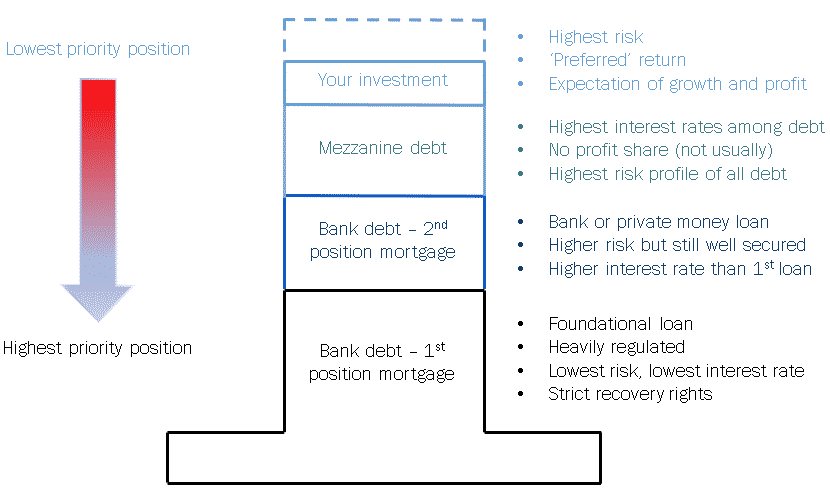
In a typical commercial real estate transaction, preferred equity occupies the layer between senior debt and common equity. Most stabilized and transitional deals follow a similar structure: senior debt funds roughly 60 to 75 percent of total project cost, preferred equity contributes approximately 10 to 20 percent of the stack, and the remaining capital is filled by sponsor and investor common equity.


This placement defines preferred equity’s risk and control profile. Senior lenders are always paid first. Preferred equity is next in line. Common equity receives distributions only after both debt service and preferred equity obligations are satisfied. This ordering is why preferred equity commands higher returns than senior loans but lower upside than common equity.


Understanding your capital stack position determines who controls cash flow, who absorbs losses, and who has leverage in negotiations. A sponsor operating with thin common equity beneath a large preferred layer may appear well capitalized on paper but in practice has limited room for error if performance slips or exit timing extends.


Visually, preferred equity functions as a buffer between lenders and the sponsor. It protects senior debt by absorbing volatility and protects preferred investors by subordinating common equity. 


The payment waterfall follows this hierarchy. Property income is applied first to operating expenses and senior debt service. Remaining distributable cash flows to preferred equity until its return obligations are met. Only after preferred equity is satisfied does common equity participate. At exit, the same priority applies. Proceeds retire debt first, then pay out preferred equity, and only then flow to the sponsor’s equity and promote.


Typical Preferred Equity Return Structures

Preferred equity returns are defined by how and when distributions are paid, not just by the headline rate. The structure you choose should match the cash flow profile of the asset and the risk tolerance of the capital provider. In practice, most preferred equity falls into one of three models, each with different implications for sponsor economics and exit math. These mechanics sit inside the deal’s waterfall structures and directly determine when preferred equity is satisfied relative to common equity and the promote.


Current Pay Preferred (Cash-Flowing Deals)

Current pay preferred equity delivers an annual return, typically in the 8 to 12 percent range, distributed monthly or quarterly from operating cash flow. This structure works best in stabilized assets with predictable income where debt service coverage leaves room for subordinate distributions.


For sponsors, the advantage is simplicity. Returns are paid as they are earned, which prevents large balances from accumulating over time. Exit math remains clean because the preferred balance does not balloon through accrual. Current pay structures also reduce investor anxiety since capital partners see regular distributions rather than waiting for a terminal event.


The tradeoff is operational pressure. Cash flow must consistently support both debt service and preferred distributions. Any disruption in income can immediately create tension between sponsor and preferred investor.


Accruing Preferred (Value-Add and Development)

Accruing preferred equity is designed for assets that do not produce distributable cash flow in the early years. Instead of receiving periodic payments, the preferred return accrues and typically compounds until sale or refinance. Typical rates range from 10 to 14 percent on an accruing basis.


This structure is common in renovation programs, lease-up strategies, and development projects where cash flow is intentionally suppressed during execution. It allows sponsors to deploy capital without draining operating income before stabilization.


Participating Preferred (Upside Sharing)

Participating preferred equity combines a base preferred return with a share of upside once a defined performance threshold is exceeded. A common structure might provide a 10 percent preferred return plus 25 percent of profits above a 15 percent internal rate of return.


This model emerges when capital partners view the deal as particularly attractive or when leverage is constrained and investors want additional compensation for risk. It gives preferred equity both downside protection and limited upside participation.


For sponsors, participation directly impacts the promote. Profit sharing above the hurdle reduces the residual pool available to common equity and carried interest. While this can be acceptable in highly accretive deals, it changes the risk reward balance. Sponsors must underwrite not just the base preferred return but the effect of participation on total sponsor proceeds at exit.

Why Sponsors Use Preferred Equity

For many transactions, preferred equity is typically selected only when necessary. Market structure, lender rules, and capital efficiency all push sponsors toward preferred equity as the default subordinate capital source.


Senior Lender Requirements

Agency and institutional lenders generally prohibit mezzanine debt because it introduces competing creditor claims and complicates foreclosure and workout scenarios. In contrast, preferred equity is structured as an ownership interest rather than a loan, which makes it compliant with most agency loan programs. This shift is visible in servicing practice as well, as the Mortgage Bankers Association notes that recapitalizations increasingly involve “adding preferred equity or restructuring layered or mezzanine debt” as servicers work with sponsors to stabilize assets under current commercial mortgage conditions according to its roundtable on top commercial mortgage servicing issues to watch.


Guidance from the Mortgage Bankers Association explains that agency multifamily lending structures restrict subordinate debt layers while allowing equity capital behind the mortgage, which is why preferred equity has replaced mezzanine debt in many modern capital stacks according to the MBA’s overview of agency multifamily lending programs.


Because preferred equity is not a creditor position, it typically does not require an intercreditor agreement with the senior lender. That removes a layer of legal complexity and cost while preserving lender priority. For sponsors using agency debt, preferred equity becomes the only practical way to introduce subordinated capital without violating loan covenants.


Capital Stack Optimization

Preferred equity fills the gap between what the senior lender will provide and what the sponsor is willing or able to contribute as common equity. That gap has widened materially as higher interest rates and lower loan to value ratios have reduced senior loan proceeds, which is why structured equity solutions have become more common as described in CBRE’s assessment of current U.S. real estate capital markets conditions. Instead of raising a larger common equity check, sponsors can introduce a preferred layer to complete the stack.


This reduces the sponsor’s required equity contribution and can increase return on invested capital for the common equity tranche. In constrained leverage environments, this function is especially important. CBRE’s capital markets research notes that tightening loan to cost ratios have increased reliance on structured equity solutions to complete transactions as outlined in its analysis of current capital markets conditions.


In transactions involving development financing, preferred equity is often the only viable substitute for mezzanine debt because construction lenders are particularly sensitive to competing claims on project cash flow and collateral.


Flexible Payment Terms

Preferred equity is also attractive because its economics can be tailored to the business plan. Returns can be structured as current pay, full accrual, or hybrid depending on whether the asset is stabilized, transitioning, or under construction.


During lease up or renovation, preferred returns can accrue until the property reaches cash flow stability. Once income is predictable, distributions can convert to current pay. This alignment between payment timing and property performance is difficult to achieve with traditional debt instruments.


Preferred equity terms are negotiated deal by deal allowing sponsors to adjust accrual periods, compounding frequency, and redemption timing to match operational reality. That flexibility is one of the primary reasons preferred equity has become dominant in modern capital stacks despite its higher headline cost.

What Preferred Equity Investors Expect

Preferred equity investors evaluate deals through a different lens than common equity partners. Their priority is downside protection and predictable outcomes, not maximum upside. Understanding these expectations is essential when structuring terms that attract capital without surrendering unnecessary control.


Return Expectations

In the current market, preferred equity investors generally target total returns in the 12 to 15 percent range, depending on risk profile, asset type, and structure. This pricing reflects broader capital allocation trends, as Preqin reports that investors are shifting toward defensive strategies such as mezzanine, distressed, and special situation approaches that continue to command higher return expectations due to their risk profile, as outlined in its update on how private debt investors are shifting to a defensive approach. Institutional capital tends to anchor toward the lower end of that band with tighter governance packages, while private capital often seeks higher returns in exchange for simpler documentation and fewer controls.


Industry data on private real estate fund structures from Preqin shows that structured equity strategies have migrated upward in required returns as leverage has tightened and refinancing risk has increased, which is reflected in the yield targets preferred equity investors now underwrite when allocating capital across real estate strategies as documented in Preqin’s research on private real estate fund structures.


Relative to common equity, preferred equity offers a higher floor and a lower ceiling. It sits ahead of the sponsor in the payment order, which limits downside exposure, but its upside is usually capped through fixed returns or limited participation. This is why preferred equity is attractive to investors who want equity economics without full equity volatility, and why sponsors must recognize that these investors are buying priority, not growth.


These dynamics align closely with broader investor preferences around capital preservation, visibility into cash flow, and clearly defined exit mechanics.


Governance and Consent Rights

Preferred equity investors typically require consent rights over major decisions that could impair their position. Standard controls include approval rights over property sales, refinancing events, and significant capital expenditures that exceed an agreed budget threshold.


Budget approval rights are common, particularly in renovation or development scenarios. Investors want assurance that capital will be deployed according to the underwriting assumptions that supported their return profile. Variances above defined limits usually require investor consent rather than unilateral sponsor action.


Manager removal rights are more sensitive. Some preferred equity agreements allow removal of the sponsor for cause, such as fraud or gross negligence. More aggressive structures permit removal upon financial default, including missed preferred payments or failure to redeem. These provisions directly affect sponsor control and must be negotiated carefully.


Information and reporting rights complete the governance package. Preferred equity investors expect regular financial statements, rent rolls, construction updates if applicable, and notice of any material events. Transparency is part of the tradeoff for priority economics.


Exit and Redemption Rights

Preferred equity is almost always written with a defined exit timeline. Mandatory redemption dates are typically set between three and five years from closing, aligning with expected refinance or sale horizons.


Sponsors may negotiate optional call rights that allow early redemption if the property outperforms or refinancing becomes attractive. These rights preserve flexibility and prevent the preferred layer from becoming a long term drag on proceeds once its economic purpose has been served.


Forced sale provisions appear when mandatory redemption is missed. If the sponsor cannot redeem the preferred equity by the required date, the investor may gain the right to force a sale of the property to recover capital. This is one of the most consequential terms in any preferred equity agreement.


Reasonable negotiation centers on timing and extensions. Sponsors should seek extension options tied to objective milestones such as stabilization or market conditions. Redemption terms should reflect the reality that capital markets do not always cooperate with underwriting schedules. A well structured exit provision protects investor capital without creating a ticking clock that overrides sound asset management.

Structuring Preferred Equity: Key Terms to Negotiate

Once the decision to use preferred equity is made, the economics are only part of the equation. The most important leverage a sponsor has is in how the preferred position is structured. Market pricing sets a general range for returns, but governance and exit mechanics determine whether preferred equity behaves as a financing tool or as a control instrument.


Return Structure

The first decision is whether the preferred return is current pay, fully accruing, or a hybrid of the two. Current pay structures shift risk to operations by requiring cash distributions during the hold period. Accruing structures shift risk to exit by allowing the obligation to grow over time. Hybrid structures attempt to balance both by deferring payments early and converting to current pay after stabilization.


Compounding frequency matters more than many sponsors expect. An annual accrual produces materially different outcomes than quarterly compounding at the same stated rate. The legal document will specify how often the preferred balance grows, and that timing directly affects the redemption amount at exit. Sponsors should model the full life cycle of the investment rather than relying on the nominal rate.


If participation is included, the mechanics must be precise. Participation may apply only after a hurdle return is achieved, and the definition of that hurdle can vary. It may be calculated on total deal profits, on the common equity tranche, or on sponsor proceeds. Each version changes how much upside is diverted from the promote and when that diversion occurs.


Governance Package

Governance rights determine how much operational control the preferred investor can exercise. Sponsors should narrow the list of major decisions to true structural events such as sale, refinance, and extraordinary capital expenditures. Routine operational matters should not require investor approval.


Approval thresholds should be calibrated to the business plan. If a renovation budget is tight, small overruns should not automatically trigger consent rights. Setting realistic variance bands allows management to operate without constant investor intervention while still protecting the preferred position.


The distinction between default and consultation is critical. Some agreements treat missed payments or budget deviations as technical defaults that trigger remedies. Others require notice and a cure period or limit investor rights to consultation rather than control. Sponsors should insist that operational setbacks are addressed through process before they escalate into enforcement events.


Redemption and Exit

Redemption terms control the clock on the deal. Mandatory redemption dates should be aligned with realistic refinance or sale horizons rather than optimistic underwriting assumptions. Sponsors should build in extension options tied to objective criteria such as loan maturity, lease up progress, or market conditions.


Call rights give the sponsor flexibility to redeem the preferred equity early if performance exceeds expectations. Without call rights, a preferred layer can remain in place even when it no longer serves a capital purpose, continuing to siphon returns from common equity.


Forced sale mechanics are the final backstop for preferred investors. If redemption fails, the agreement may permit the investor to require a property sale. Sponsors must understand exactly how that right is exercised, who controls the process, and how sale proceeds are allocated. The goal in negotiation is not to eliminate this protection but to ensure it is triggered only after reasonable extensions and cure opportunities have been exhausted.


Structuring preferred equity is therefore less about the stated return and more about aligning incentives. Well negotiated terms preserve sponsor control while delivering the priority economics that preferred investors expect.


Common Mistakes with Preferred Equity

Preferred equity solves real capital problems, but it introduces structural risks that are easy to underestimate. The most expensive errors tend to be mathematical or contractual rather than strategic. Sponsors who treat preferred equity as just another tranche often discover its impact only when exit economics or control rights surface under pressure.


Underestimating Total Cost

The most common mistake is treating an accruing preferred return as simple math. A 12 percent preferred return accruing for four years does not equal 48 percent in total cost because they are often compounded returns (not, actually ‘accrued’) and compounding materially changes the obligation.


In practice, compounding can add 15 to 25 percent to the total payout compared to a simple rate assumption. Sponsors who model only the stated return rather than the accumulated balance routinely underwrite exits that cannot support the redemption amount. The correct approach is to model the actual dollar payment at exit under conservative timing assumptions, not just the annual percentage.


This mistake is especially damaging in value add and development deals where timelines slip and accrual periods extend.


Accepting Overbroad Governance Rights

Another frequent error is agreeing to governance packages that extend beyond genuine risk protection. Preferred equity agreements often define major decisions that require investor consent. If that definition includes routine operational actions such as lease approvals, minor budget reallocations, or standard vendor contracts, sponsors lose practical control of the asset.


Low approval thresholds compound the problem. When modest cost overruns or timing variances trigger consent rights, execution slows and accountability blurs. Vague manager removal provisions create additional risk. If removal can occur for loosely defined performance failures rather than clear misconduct, sponsors operate under constant threat of displacement.


As CEO and Founder, WealthMigrate Scott Picken observed, in the context of capital alignment:

We do not invest in property, we invest in partners. Your alignment and structure matter as much as the asset itself.”

- Scott Picken, CEO and Founder, WealthMigrate

Ignoring Redemption Pressure

Redemption terms create a clock that does not always align with market reality. Mandatory redemption dates with no extension options effectively embed a forced sale clause into the capital stack.


If refinancing conditions tighten or transaction markets freeze, the sponsor may be unable to redeem on schedule. In those cases, preferred equity investors can gain the right to force a sale, even if holding the asset would be economically rational.


Sponsors often assume that refinancing will always be available when the redemption date arrives. That assumption ignores interest rate cycles and capital market shocks. Extension options tied to objective milestones or market conditions are not optional protections. They are structural necessities.


Preferred equity fails sponsors not because it is flawed, but because it is misunderstood. The discipline is in modeling the full cost, narrowing control rights to true risk events, and aligning redemption timing with realistic exit scenarios.

Frequently Asked Questions

How is preferred equity different from mezzanine debt?

Collapse

Preferred equity is structured as an ownership interest, not a loan. It receives priority distributions over common equity but remains subordinate to senior debt. Mezzanine debt is contractual debt secured by a pledge of equity interests and typically requires an intercreditor agreement with the senior lender. This distinction is why preferred equity is often permitted when mezzanine debt is prohibited under agency loan programs.

What’s a typical preferred equity term length?

Can preferred equity investors force a sale of the property?

How does preferred equity affect my promote and waterfall?

Is preferred equity more expensive than mezzanine debt?

Closing

Preferred equity fills a critical gap in modern real estate capital stacks by providing flexible subordinate capital without violating senior lender constraints. It allows sponsors to close leverage gaps, preserve control, and tailor payment timing to the realities of operations and development.


The discipline is in structure. Returns, governance rights, and redemption terms must be aligned with the business plan rather than forced into generic templates. When modeled correctly and negotiated carefully, preferred equity can enhance sponsor outcomes instead of constraining them.

Actionable strategies to raise more capital and scale faster - enhanced by AI, all in just five minutes. Subscribe here.

About Dr. Adam Gower

Dr. Adam Gower is the founder of GowerCrowd and a leading authority on real estate syndication and crowdfunding. With 30+ years in real estate and $1.5B in transactions, he helps sponsors build marketing systems that attract high-net-worth investors.

30+ Years Experience | $1.5B In Transactions | 30,000+ CRE Professional Community

Learn more about Adam